What's the difference between changing a lock and rekeying it?
These two services solve different problems, and choosing the right one saves you money. Changing a lock means removing the old hardware entirely and installing a new lock body, so both the mechanism and the keys are new. Rekeying keeps your existing lock but resets the internal pin-and-spring stack inside the cylinder so that a different key operates it and the old keys stop working. Rekeying is typically the faster, lower-cost option when the lock itself is in good shape and you simply want old keys to stop working, for example after a move or losing a key.
A full lock change is the better choice when the hardware is worn, corroded, or damaged, when the lock is an older or low-grade design you want to upgrade, when the finish or style no longer matches the door, or when you want a different lock type altogether, such as moving from a basic knob to a graded deadbolt or a smart lock. Because a change replaces the whole unit, you also reset any wear in the bolt, latch, and springs that an older lock may have built up.
When you request a quote, we look at the condition, grade, and age of what's on the door now and tell you honestly whether a rekey would do the job or whether a change makes more sense. We don't push a replacement when a rekey is genuinely the better value for your situation.
Which locks can you change and install?
We work with the common residential and light-commercial lock types found on doors across San Jose and the South Bay. The right choice depends on the door material, how the door is used, and the level of security you want.
Lock grades are worth knowing about. ANSI/BHMA rates builders' hardware Grade 1, 2, or 3, with Grade 1 being the most durable and Grade 3 the most basic; many homeowners step up to a Grade 2 or Grade 1 deadbolt for exterior doors. We can explain the trade-offs for your specific doors when we visit.
- Deadbolts: single-cylinder (thumb-turn inside, key outside) and double-cylinder (keyed both sides) options, plus graded models for added durability
- Knob and lever sets: entry, passage, privacy, and ADA-friendly lever handles
- Smart locks: keypad, Bluetooth, Wi-Fi, and keyed-plus-electronic models from mainstream brands
- High-security and restricted-key cylinders for added pick and bump resistance
- Mortise locks common on older and commercial doors
- Patio, sliding-door, and secondary locks, plus strike-plate and door-reinforcement hardware
What does a lock change or installation appointment involve?
A typical visit starts with a quick look at the door and frame, because a lock is only as strong as what it's mounted in. We measure the existing prep: the bore hole (commonly 2-1/8 inches), the cross-bore for the latch (commonly 1 inch), the backset (the distance from the door edge to the center of the bore, usually 2-3/8 or 2-3/4 inches), and the door thickness. Matching these dimensions is what lets a new lock seat correctly and operate smoothly.
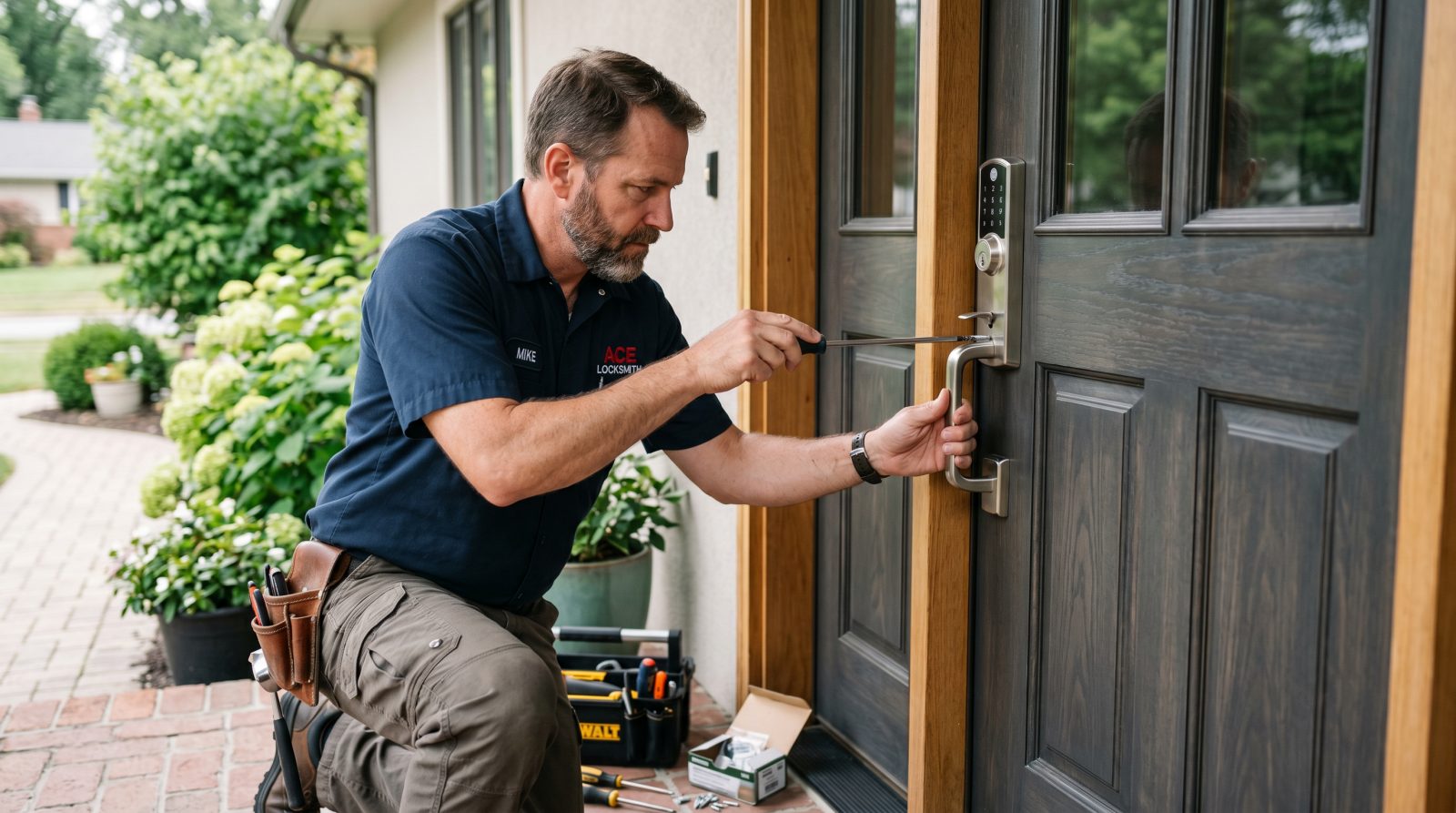
From there we remove the old hardware, fit the new lock body and latch, install the strike plate on the frame, and adjust the alignment so the bolt throws fully and the door doesn't bind. For a deadbolt, we confirm the bolt extends its full length into the strike for proper hold. For a smart lock, we mount the unit, set up the keypad or app, program your codes, and walk you through daily use, battery replacement, and how to reset it later. New locks come with their own keys, and we hand over every key for the locks we install.
If your door needs new prep for a deadbolt that isn't there yet, or the existing holes don't line up, we'll tell you before drilling so you know exactly what's being done. We finish by testing the lock multiple times from both sides to confirm clean operation before we leave.
When should you change your locks?
There are a handful of moments when changing or installing locks is a smart move. Moving into a new home or rental is the most common one, because you can't know how many copies of the old keys are out there. Industry guidance generally recommends getting new keys to your home after a move so any previously issued keys no longer work.
Other good reasons include a lock that sticks, grinds, or is hard to turn, a key that has broken off or no longer operates smoothly, visible damage or corrosion on the hardware, or an attempted forced entry. Upgrading is also a valid reason on its own: stepping up from a basic knob-only door to a graded deadbolt, adding a deadbolt where there isn't one, or switching to a keypad or smart lock so you can stop carrying a physical key. If you've handed keys to contractors, former roommates, a property manager, or anyone you no longer want to have access, a change or rekey restores control over who can open your door.
How much does a lock change cost in San Jose?
Pricing depends on the type and grade of lock, how many doors and locks are involved, the hardware you choose, and the condition of the door. The figures below are typical industry estimate ranges to help you plan, not quotes, and they don't include the price of the lock hardware itself unless we supply it. Premium smart locks, high-security cylinders, and doors that need new prep or repair sit at the higher end.
Service labor for a standard residential lock change commonly falls in roughly the $75 to $200-plus per-lock range across the industry, with smart-lock setup and high-security hardware costing more. Because every door is a little different, the only way to know your real number is a quote. Tell us how many doors you have and what you'd like installed, and we'll give you an estimate up front, before any work starts. Door condition and hardware choice genuinely change the cost, so we look at the actual door before putting a number to the job.
- Single residential deadbolt or knob change: typical labor range, lower end
- Multiple exterior doors matched to one key: priced per lock, often with savings on volume
- Smart lock or keypad installation and programming: higher end, varies by model
- High-security or restricted-key cylinders: higher end, hardware-dependent
- Doors needing new bore prep or alignment work: add-on depending on what's required
Why choose Locksmith San Jose for lock changes?
We're a local mobile locksmith, which means we bring the tools and common hardware to your door across San Jose and the South Bay, from Willow Glen and Cambrian Park to Almaden Valley, Berryessa, Evergreen, and the surrounding South Bay communities. Coming to you means we can measure the actual door, match the prep correctly the first time, and adjust on the spot if something needs it.
Our approach is straightforward: assess the door, explain whether a rekey or a full change is the right call, recommend a lock grade that fits how you use the door, and give you the estimate before we begin. We focus on doing the install cleanly so the lock operates smoothly over the long run, not just on the day. To get started, request a free quote and tell us what you need, and we'll take it from there.