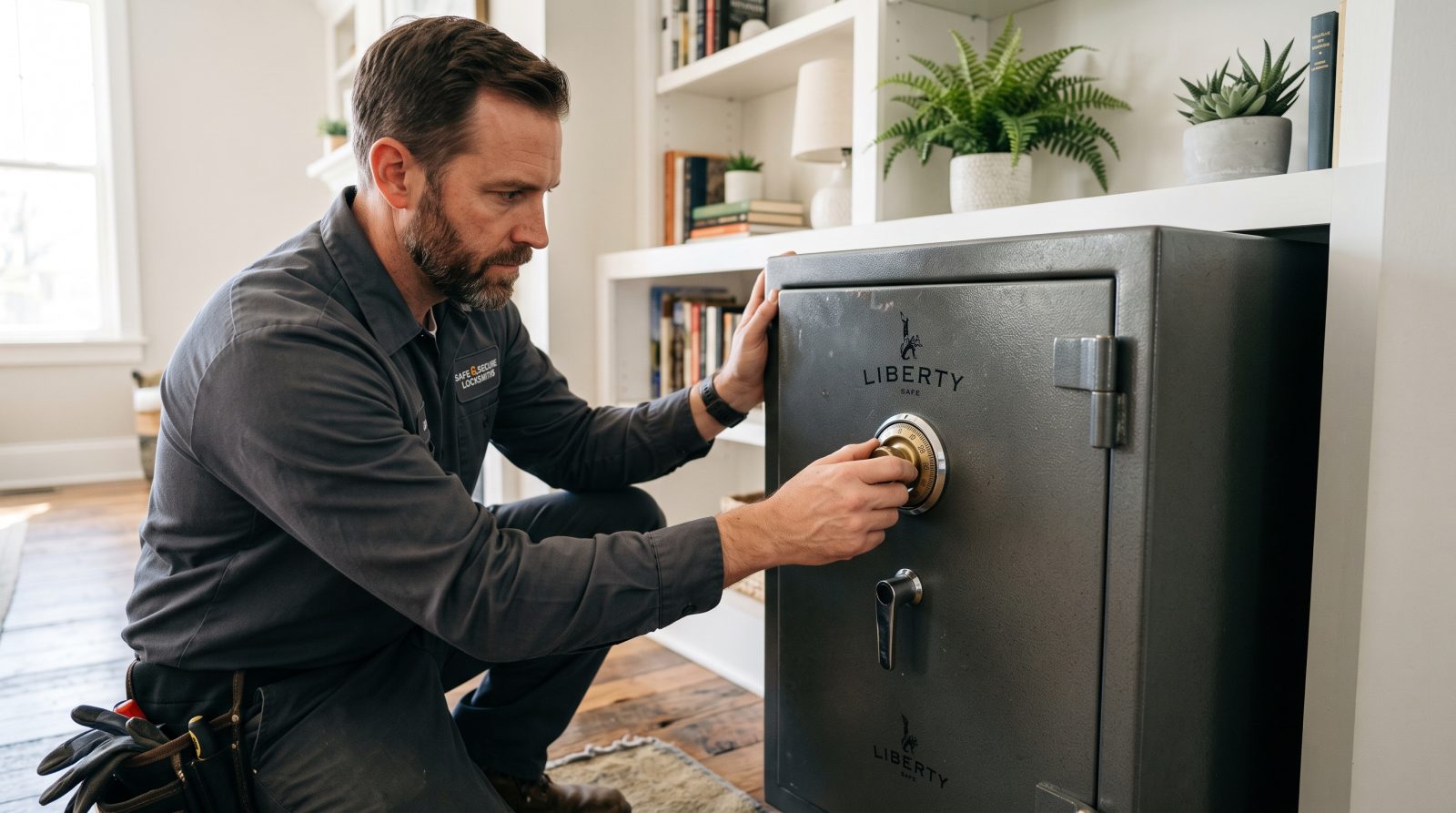
What does a safe locksmith do?
A safe locksmith is a locksmith who specializes in the locks and mechanisms used on safes rather than on doors. The core jobs fall into three buckets: opening a safe you can't get into, repairing a lock or mechanism that has failed, and changing the combination or code so old credentials no longer work. Many calls also involve diagnosing why a safe stopped opening in the first place, since the fix for a dead keypad battery is very different from the fix for a dropped relocker.
Safes use several lock types, and the approach depends on which one you have. The most common are mechanical dial (group-2 combination) locks, electronic keypad locks with a battery, biometric locks that read a fingerprint, and key-only or dual-control locks that need both a key and a code. Higher-grade safes add internal security features such as relockers and hardplate that are designed to lock the safe down if someone tampers with it, which is exactly why professional, non-destructive technique matters.
- Open locked-out safes: dead keypad, forgotten combination, jammed bolt, or unknown code on an inherited safe
- Repair safe locks: replace failed keypads, service worn dial mechanisms, and address bolt work that won't retract
- Change combinations and codes on mechanical and electronic safes so previous users lose access
- Replace lost safe keys and re-key dual-control safes
- Diagnose why a safe won't open before recommending the least-invasive fix
Safe opening: what a lockout call actually involves
When you're locked out of a safe, the first thing a technician does is verify that you have the right to open it. For a home or business safe, that typically means confirming you own or control the property where the safe sits and, where relevant, that you're authorized to access its contents. This step protects you and is standard practice for legitimate safe work.
Next comes diagnosis. A surprising share of 'locked' safes are not broken at all: electronic keypads commonly go dark or stop responding because the 9-volt battery has died, and many models will work again once a fresh battery is installed and the correct code is entered. Other safes are jammed because an item inside is blocking the bolts, the handle was forced, or the lock was left partially engaged. A good technician rules out the simple causes before anything else.
If the safe genuinely needs to be opened by a locksmith, the goal is to get it open with the least damage possible. Depending on the safe's make, model, and lock type, that can mean working with a mechanical dial, recovering or resetting an electronic lock, or accessing the mechanism through a controlled, repairable point. Whether an opening can be truly non-destructive depends on the specific safe and its security rating, and a higher-security safe with hardplate and relockers may require more involved work. We will not describe bypass methods publicly, but we will explain your options for your specific safe before starting.
- Ownership and authorization verified before any opening work begins
- Simple causes checked first: dead keypad battery, jammed bolts, partially engaged lock, blocked door
- Least-invasive method chosen for your safe's make, model, and lock type
- Clear explanation of likely outcomes, including whether the lock can be reused afterward
Safe repair and combination changes
Once a safe is open, or if it still opens but doesn't work reliably, repair is often the next step. Electronic locks are frequently serviced by replacing a failed keypad or the lock body, after which the safe works normally again. Mechanical dial locks can develop drift, stiffness, or wear in the wheel pack over years of use; servicing or replacing the mechanical lock restores smooth, dependable operation. Bolt work, hinges, and handles can also be repaired or replaced when they bind or fail.
Combination changes are one of the most common reasons people call a safe locksmith even when nothing is broken. You should change a safe's combination whenever someone who knew the old code no longer should have access, after you buy a used safe, when an employee with the code leaves, or simply because you've never changed the factory default. On a mechanical dial safe, changing the combination usually requires a change key and access to the back of the lock, which is why it's done by a technician rather than from the keypad. On an electronic safe, the technician can set a new master code and, on many models, additional user codes so you control who gets in.
If you've lost the key to a key-operated or dual-control safe, replacement keys can often be made, and the lock can be re-keyed so the lost key no longer works. As with opening, all of this depends on the specific safe, and the technician will tell you what's possible for your unit before any work.
- Electronic lock repair: replace failed keypads and lock bodies
- Mechanical dial service: address worn or stiff wheel packs and dial mechanisms
- Combination changes on mechanical and electronic safes, including clearing factory defaults
- New and reset user codes on electronic safes so you control access
- Lost safe key replacement and re-keying for key-operated and dual-control safes
Safes we work on in San Jose
We service the kinds of safes most common in San Jose homes and South Bay businesses. On the residential side, that includes small home safes and document safes, fireproof safes, gun and firearm safes, and wall or floor safes built into a closet or slab. On the commercial side, that includes drop and depository safes, cash-handling safes used in retail, and office safes for documents and backups.
Different safes carry different security ratings, and that rating affects both how the safe behaves during a lockout and what repair makes sense. A basic big-box home safe is a different job from a heavy gun safe with a UL-listed group-2 mechanical lock, which is different again from a high-security commercial unit with hardplate and multiple relockers. When you request a quote, telling us the brand, the approximate size, and whether the lock is a dial, a keypad, biometric, or key-operated helps us give you a more accurate estimate range.
- Home and document safes, including fireproof models
- Gun and firearm safes with mechanical, electronic, or biometric locks
- Wall and floor safes built into the structure
- Commercial drop, depository, and cash-handling safes
- Office and records safes for businesses
Typical safe locksmith costs in San Jose
The figures below are typical estimate ranges to help you plan, not quotes for your specific job. Actual price depends on the type and security rating of the safe, the lock involved, the cause of the problem, and whether the safe can be reused afterward. A home safe with a dead keypad battery sits at the low end; a high-security safe that needs a relocker reset and a new mechanical lock sits much higher. You'll always get an estimate for your situation before work begins.
Several factors push a job up or down within these ranges: the safe's security rating and construction (hardplate and relockers add complexity), whether opening the safe damages the lock and requires replacement, the lock type being installed or serviced, and the safe's location and accessibility. A floor safe set in concrete or a heavy gun safe in a tight closet can take longer to access than a portable home safe on a shelf.
- Safe opening (basic home or electronic safe): roughly $100 to $250, estimate only
- Safe opening (high-security or damaged lock): often $250 to $600 or more, depending on the unit
- Combination or code change: commonly $75 to $200, estimate only
- Electronic keypad or lock replacement: commonly $100 to $300 plus the lock, estimate only
- Lost safe key replacement or re-key: varies by lock; ask for an estimate
- These are typical estimate ranges, not fixed prices; your estimate comes first
How to request safe locksmith service
To get help with a safe, request a free quote and describe your situation. The more detail you can give up front, the more accurate your estimate will be: the brand and approximate size of the safe, whether the lock is a mechanical dial, an electronic keypad, biometric, or key-operated, what's happening (locked out, keypad dead, combination unknown, lock failing), and where the safe is located. If it's an inherited or used safe with an unknown code, mention that too.
Because safe access is sensitive, expect to verify ownership or authorization before opening work. This is normal and protects everyone involved. We serve San Jose and the surrounding South Bay as a mobile locksmith, and we'll confirm what's possible for your specific safe and lock before any work starts so there are no surprises.
- Have your safe's brand, size, and lock type ready
- Describe the problem: lockout, dead keypad, unknown combination, or failing lock
- Be prepared to verify ownership or authorization for opening work
- Request a free quote to get an estimate for your specific safe